
Compton Wood Flooring builds, converts and refinishes hardwood stairs in Compton, CA, serving surrounding cities including East Rancho Dominguez, Willowbrook, West Rancho Dominguez, Lynwood and Watts, with more than 20 years of wood floor and stair work behind us. Stairs are the most visible piece of flooring in a two-story house and the hardest to get right, because every step is a separate small job with its own measurements, cuts and fasteners.
We price stairs per tread and riser rather than hiding them inside a square-foot number. That keeps the estimate honest, since a full staircase can take as much labor as a large room of open floor, and it lets you compare quotes step for step.
Whether you want to turn carpeted stairs into hardwood, refinish worn treads to match a newly restored floor, or replace damaged stair parts, we plan the stairs together with the floor they connect to. The goal is one continuous look from the bottom landing to the top hallway.
Converting Carpeted Stairs to Hardwood
What Is Under Stair Carpet
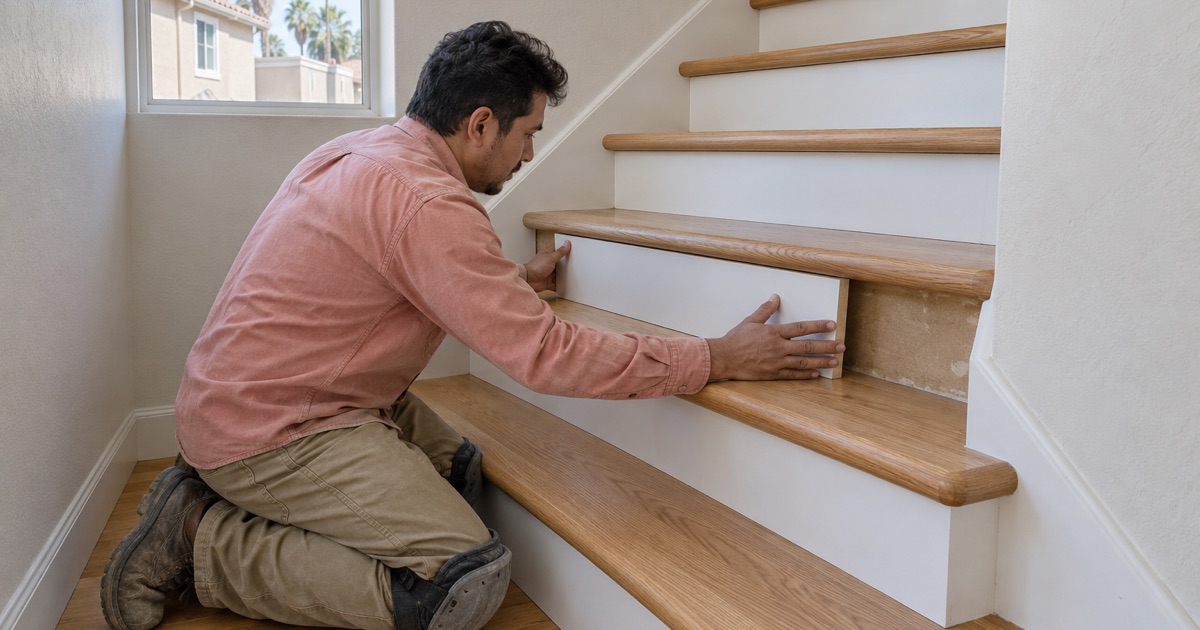
When stair carpet comes up, it often reveals rough construction-grade treads never meant to be seen, sometimes with a bullnose that sticks out past the riser. Other stairs have real hardwood treads that were carpeted later. We remove carpet, pad, tack strip and staples, then check each step to decide whether it can be refinished, capped or needs new treads.
The stringers and framing underneath are checked as well. A loose or squeaky stair usually has a tread that has worked free from its stringer or a riser that has pulled away, and those are fixed before any new wood goes on.
Cutting Back and Capping Treads
When existing treads are rough, we cut back the overhanging nose and install new hardwood treads over them, or remove the old treads entirely and set new ones on the stringers. Each tread is measured individually, since stairs in older houses are rarely perfectly uniform. The new stair tread is glued and fastened so it will not squeak.
Consistent rise from step to step matters for safety, and capping every tread except one can leave the top or bottom step a different height from the rest. We account for the added thickness at the landing and the bottom floor so each step still rises the same amount, rather than creating a step that catches a foot.
New Risers and Stair Nosing
Risers can be painted wood for contrast or hardwood matched to the treads. The stair nosing at the top landing, where the stairs meet the upper floor, is fitted to the height of the finished floor so there is no lip to trip on. Getting that transition right is one of the details that separates a finished staircase from a patched one.
Painted risers are popular because they are easier to keep clean than wood and brighten a dark stairwell. We prime and paint them before the treads are finished, so the paint line along each tread stays crisp.
Refinishing Existing Hardwood Stairs
Hand-Sanding Treads and Risers
Stairs cannot be sanded with the large machines used on open floors, so each tread, riser and nosing is sanded by hand or with detail sanders. That takes time, and it is why we price stairs by the step. The result is a surface as smooth and even as the floor it meets.
Worn areas in the center of each tread, where traffic concentrates, often need more sanding than the edges. We blend them carefully so the finished tread is flat across its whole width rather than slightly dished in the middle.
Repairing Cracked and Loose Treads
A cracked tread or a split nosing is both a looks problem and a safety one. We replace damaged treads with matched hardwood and resecure loose ones to the stringers. Squeaks are addressed from below where the underside of the staircase can be reached.
Where the underside is closed in by drywall, we work from above with glue and hidden fasteners set through the tread into the stringer. The holes are filled and blended into the new finish, so the repair holds without leaving a row of visible screw heads on each step.
Matching Stain to the Floor
When stairs and floors are refinished at the same time, we stain and coat them together for a consistent color. When stairs are done alone, we test stain on a hidden area first, since stair parts may be a different species or age than the floor.
Materials and Finishes for Stairs
Choosing a Species for Stairs
Stairs take concentrated wear at the nosing and the center of each tread. White oak and red oak are the common choices and match most floors, while hickory offers higher hardness on the Janka scale for busy households. We usually match the species to the adjoining floor so the transition reads as one surface.
Finish and Traction
We apply finishes that meet the South Coast air district’s 275 g/L wood-coating limit, and we usually recommend satin or matte sheen on stairs. Lower sheen hides wear and is less slippery than gloss. Where extra traction is wanted, we can plan for a runner and leave the tread edges finished.
Handrails and Balusters
Handrails and balusters often need attention when the stairs are redone. We can refinish existing handrails, tighten loose balusters and match new rails to the stairs. A staircase with fresh treads and a worn rail still looks unfinished.
Stairs in Older and Rental Homes
Lead-Safe Work on Older Stairs
Stair risers, stringers and rails in houses built before 1978 often carry old paint that may contain lead. We follow lead-safe work practices when sanding or removing painted stair parts, with containment and cleanup that keep dust out of the rest of the house.
Stairs for Rentals and Inspections
Loose treads, broken nosing and damaged stair covering are trip hazards that inspections look for, including under HUD’s NSPIRE standard for voucher units. We repair and document stair work with itemized invoices, so landlords have a record of what was fixed and when.
- 20+ Years of Wood Flooring
- Written Scopes and Estimates
- Free Estimates