
Compton Wood Flooring handles hardwood floor repair for homes in Compton, CA, serving surrounding cities including East Rancho Dominguez, Willowbrook, West Rancho Dominguez, Lynwood and Watts, and we have been fixing wood floors for more than 20 years. Most of the repairs we see here are on older oak strip floors: a split board by the back door, a ring of damage around an old water heater closet, a hallway patch left behind when a floor furnace came out. Each one can usually be fixed without replacing the whole floor.
Good repair work is invisible. That means cutting out damaged boards cleanly, finding replacement wood that matches in species, width and thickness, and weaving it into the existing floor so the seams are staggered the way the original installer laid them. A plywood square screwed over a hole and hidden under a rug is not a repair, and it will fail inspection when you sell.
We look under the floor as well as at it. A damaged board is often a symptom, and the cause may be a leak, a loose subfloor, a termite colony or a settling joist. Repairs last when that cause is found and fixed first.
Board Replacement and Weave-In Repairs
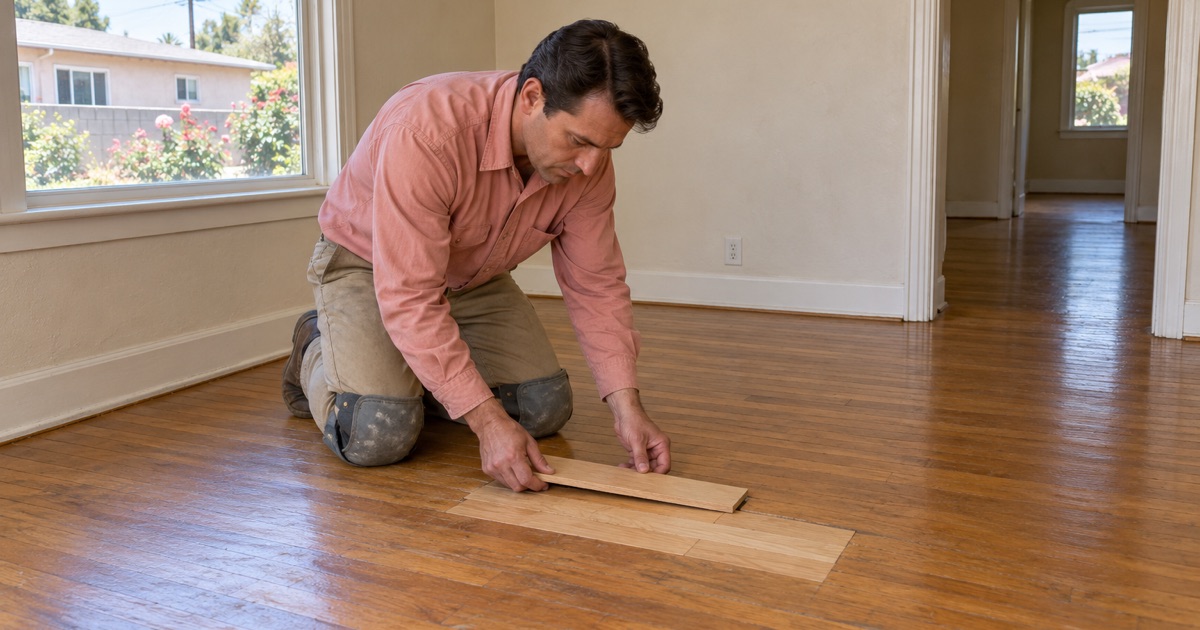
Cutting Out Damaged Boards
Deep gouges, split boards, burns and areas soaked by pet urine are cut out one board at a time. We remove each damaged board without damaging the tongue or groove of the neighbors, so the replacement locks in tightly. The goal is a repair you cannot find by walking on it.
The cutting is done with a plunge saw set to the exact thickness of the flooring, so the subfloor underneath is not scored. Old nails are pulled or set below the surface, and the opening is vacuumed before the new board goes in, so nothing lifts it out of plane.
Weaving In Matching Wood
A weave-in repair staggers replacement boards into the existing floor so the end joints do not line up in a visible block. We match the width and thickness of the original, and on older floors we check the tongue-and-groove profile as well, since mills changed profiles over the years. When the original species or width is no longer sold, we pull boards from a closet or mill new stock to match.
This is also how we close old floor furnace openings. The hole is framed between the joists, sheathed with plywood, and the surrounding floor is woven in board by board, so the patch disappears once the room is sanded and finished.
Blending the Finish on a Repair
A new board next to decades-old boards will not match until it is sanded and finished with the floor around it. On smaller repairs we sand and finish to a natural break, like a doorway. On larger ones we often recommend refinishing the whole room so color and sheen are even from wall to wall.
Fixing Movement, Gaps and Noise
Board Gaps and Seasonal Movement
Wood takes on and gives up moisture with the seasons, so some gap movement is normal. We measure moisture content with a wood moisture meter and look at whether gaps open across the whole room or only in one area. Stable gaps can be filled; moving ones need the cause addressed or they will crack any filler out.
Squeaks and Nail Pops
Squeaks come from boards rubbing against each other or against loose nails, and nail pops are fasteners working up through the surface. From a crawlspace we add blocking or screws to pull the subfloor tight to the joists. From above we use hidden fasteners that break off below the surface, then fill and touch up.
A hollow sound on a glue-down floor is a different problem: the adhesive has released. We can often inject adhesive through small holes and weight the boards while it cures, which saves pulling up a section that is otherwise sound. Where the release is widespread, re-laying the area is the honest recommendation.
Cupping, Crowning and Buckling
Cupped boards with raised edges point to moisture coming from below, often a crawlspace with poor ventilation or a slow plumbing leak. Crowning is the reverse, and buckling means boards have lifted off the subfloor entirely. We find the moisture source before touching the floor, because sanding a cupped floor flat while it is still wet leaves it crowned once it dries.
Once the source is fixed, the floor is given time to dry and we check it with a meter again. Many cupped floors settle back close to flat on their own, and those need far less sanding than a floor sanded in a hurry.
Termite, Pest and Pet Damage
Drywood Termite Damage
Drywood termites live inside the wood itself and leave small kick-out holes and piles of termite frass that look like coarse sand. Termite swarmers appearing indoors, usually near windows, are a sign of a colony nearby. After a pest company treats the house, we remove damaged boards and replace them with matched wood.
Drywood damage is often wider than it looks from the surface, because the galleries run along the grain inside the board. We probe each board around the visible holes and keep cutting until we reach sound wood, so the repair does not stop one board short of the damage.
Subterranean Termites and Powderpost Beetles
Subterranean termites come up from the soil through mud tubes and hollow out wood from the inside, often starting at the sill plate or floor joists before reaching the finish floor. Powderpost beetles leave tiny round holes and fine powder. Both can weaken framing, so we probe the joists and subfloor around any damaged area and repair the structure as well as the boards.
Where a joist has lost strength, we sister a new member alongside it rather than simply patching the floor above. Joist sistering restores stiffness to the framing, so the repaired area does not flex or sag differently from the rest of the room once furniture is back on it.
Pet Urine Stains in Oak
Pet urine reacts with the tannins in oak and turns it dark gray or black, and the stain often runs deeper than sanding can reach. We test the affected area and replace boards where the stain has gone through. Where the stain is shallow, a light sand and spot treatment may be enough, and we try that first.
Repairs Tied to Selling or Renting
Presale Inspection Items
Compton’s presale inspection walks every room and closet, and a soft spot, lifted board or plywood patch can end up on the report. We repair those items and provide a written scope describing what was done, so the seller has something clear to hand over in escrow.
The report stays valid for a limited time, so timing matters. We schedule presale repairs around the listing date and the inspection, and where a repair needs a permit through the Compton Building and Safety Division, such as structural framing work, we say so up front rather than letting it surface during escrow.
Rental Repairs and Deposits
Between tenants, a landlord often needs a few boards replaced and a traffic lane recoated rather than a whole new floor. We itemize each repair on the invoice with photos, which helps separate normal wear from damage under California’s security deposit rules and gives the unit a sound floor for the next tenant.
- 20+ Years of Wood Flooring
- Written Scopes and Estimates
- Free Estimates